Real Blaster Breakdowns: What They Really Cost.

Updated: Jul 6
Here is what I've seen in many plants: machines age, staff turns over faster than ever, and few get to know a machine long enough to learn its features. So when it breaks, you're facing something that runs a certain way — and nobody left knows why.
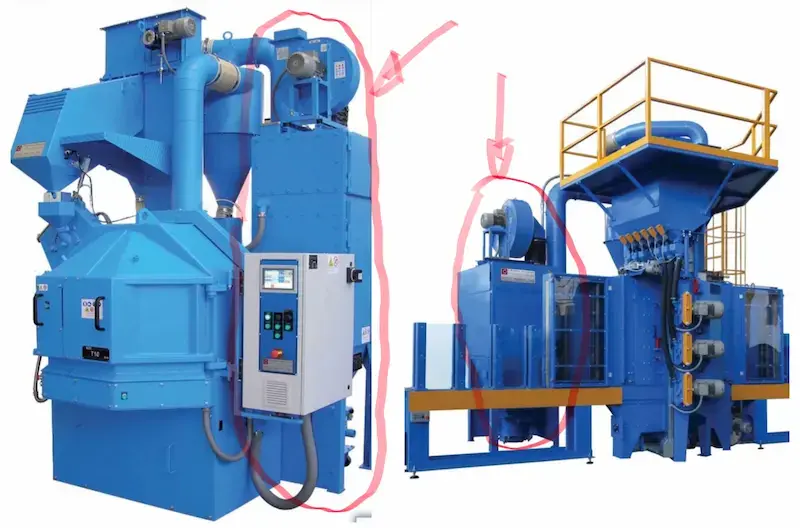
A blaster is relatively simple equipment, here you find how it is made & works, with the unique feature of being a self-destroying machine just because it operates. First question should be: do we have wear parts ready and available? And someone ready to install them?
Real cases: what an inspection fixes, and what skipping it costs.
Case 1: Glass Plant, 14-Year-Old Shot Blast Machine with a $200 missing spare.
Inside the mold shop of a 3 IS-machine line glass factory, the equipment was cleaning molds since it was commissioned 14 years before, then no care policy had been applied so while I visited them by chance I found:
Cycle time had drifted from 4 to 20 minutes.
Media consumption was way off — media type had been changed without any other adjustment.
Dust collector working badly.
No wear parts available in the factory.
The machine was still running, nobody had any idea it wasn't running as it should.
Everything was in the report I made, again machine was running, nobody cared.
Two years later a $200 funnel part feeding the turbine had failed. Lead time: 14 days, held up by customs. That was the moment everything stopped, because company did NOT want to have a minimum set of spares at hand. OPEX was ballooning and cycle time even worse.
"The more you pay" consequence 1.
When they finally called, the first thing flagged was the two-year-old report — still accurate in its warnings, but no longer current enough to prescribe exactly what was needed. A new on-site inspection was proposed to get a real picture of the machine before ordering anything: $4k all in, one week turnaround. Flights run every day.
They declined.
"The more you pay" consequence 2.
Instead, they ordered $35k in spare parts based on the old report, "what if this is missing...". $15k was used. The remaining $20k is sitting on a shelf, waiting for a problem that may or may not come — bought not out of necessity, but out of uncertainty that a current inspection would have resolved.
Summary: wasted spend, still worth it.
What they spent: $35k parts + $9k intervention = $44k.
What it would have taken with an inspection first: $4k inspection + $15k parts + $9k intervention = $28k.
The $4k they refused cost them $16k in parts they didn't need — $20k of which is still sitting on a shelf. A new machine would have cost $150k.
Results: media consumption at 0.7kg/h from 8.2kg/h, cycle time back to 4 minutes.
Conclusion 1.
The 14-year-old machine is running better than it has in the last years. The $200 part that started it all is installed and forgotten.
Conclusion 2.
A plant like that one described has about $50M revenues, about $1M/week. Mould shop shutdown was 3 weeks - average $3M loss.
This is the impact of an "old" uncared-for blaster, and what they really paid, the intervention and spares cost almost nothing.
The lowest cost to keep your blaster efficient and your OPEX reasonable.
Here's the truth about most plants: turnover is high enough that few people ever get the time to really know the machines. You end up chasing problems and solving them one at a time. And no matter how capable and well-trained the in-house team is, that mode of working doesn't give anyone the whole-machine picture — the view that catches the problems quietly building up, the ones that turn destructive.
So the point isn't spending money on an inspection. It's spending a little to keep the whole machine under control, and to avoid the stops that get enormously expensive — like the one above.
The easiest way to do that is a combination of two things: a tool that's always on hand for the team, and a scheduled inspection planned ahead.
The tool is the Vortex App — my troubleshooting method built into it. It reads your machine's own manual and walks the team through a fault the moment it shows up, one problem at a time. That's what it's built for, and it means your maintenance people always know where to turn in the heat of the moment.
The scheduled inspection is what the app can't do: an expert looking at the whole machine, in person, before problems stack up. Because two or three things out of parameter at once feed each other — you can't read that interaction from a screen. And because it's planned ahead, the costs come compressed and optimized: travel, parts, downtime, all arranged instead of scrambled for.
Together, the machine is followed. The team has someone to call. And the problems get caught before they escalate into the kind that stop the machine — and the production behind it.
The best move, then, is simple: ask for a quote. Since the real value is in combining the two — and since planning ahead is what compresses the costs — a quote is where we line them up: the diagnostic tool always on hand, and the periodic inspection scheduled in advance. Put together, they keep the machine followed and the problems close to none.
⬇️ Contact ⬇️
These cases studies illustrate the concepts discussed in: