
Friday It Worked, Monday It Doesn't. Nothing Broke — This Is Process Drift.

Updated: Aug 19
Why nothing is in alarm and the parts are still inconsistent.
Start where the problem is actually seen mainly: on the parts.
The result changes from one batch to the next.
You have a result you expect — a degree of cleanliness, a deburring level, a surface consistent enough for whatever happens next. One batch has it. The next one does not. Same settings, same machine, nothing touched in between.
The parts are fine, but the cycle time has doubled.
Or the parts are fine, but checking overall, the process timing for the same quantity of parts has doubled. Going a little bit deeper: you are using a closed cabinet layout, which runs on cycle time, and the cycle time is doubled. You spend double the time to reach the same goal as before. It is more difficult for this to happen on a pass-thru machine, because reducing the speed of the pass-thru immediately shows up as a deficiency of the entire line. Still, it happens.
The abrasive media consumption makes no sense any more.
Or the abrasive media consumption has turned into a number that makes no sense at all against a few months ago, or a year ago. It used to run at around one kilogram per hour. It is now five to seven kilograms per hour, with no reason and no practical explanation behind it.
Now imagine a real quality gate at the end of the finishing process — one that does not look only at the parts.
In the first case you find an embarrassing percentage of parts rejected. In the second case the overall production efficiency has collapsed, because it takes twice the time to do the same job as before. In the third case it is cost control asking how it is possible that you are spending four to five times more on abrasive media to run exactly the same volumes as before.
That is what makes this hard to attack. The machine runs. The cycle completes. The panel is green.
The parameters look good, so everything should be working. It is not. What you have is what is written above, or a mix of all of them.
So why?
And this is where shop-floor arithmetic stops matching the arithmetic on the datasheet. Two deviations, each one inside tolerance, do not produce a deviation inside tolerance. They do not add up — they compound. As they say on the floor: sometimes one plus one makes eleven.
That is not just a figure of speech. Winoa, one of the largest abrasive media producers in the world, has measured it: allow 10% of fines to stay in circulation and wheel wear accelerates by around 20%. A 10% defect in one place returns a 20% effect somewhere else — and that effect then feeds back into the first, because a worn wheel throws a less consistent stream, which loads the separator, which lets more fines through. Nothing in that loop needs anybody's help to get worse.
Which is why "what broke?" has no answer here. Nothing broke. Everything moved a little, in the wrong direction, at the same time.
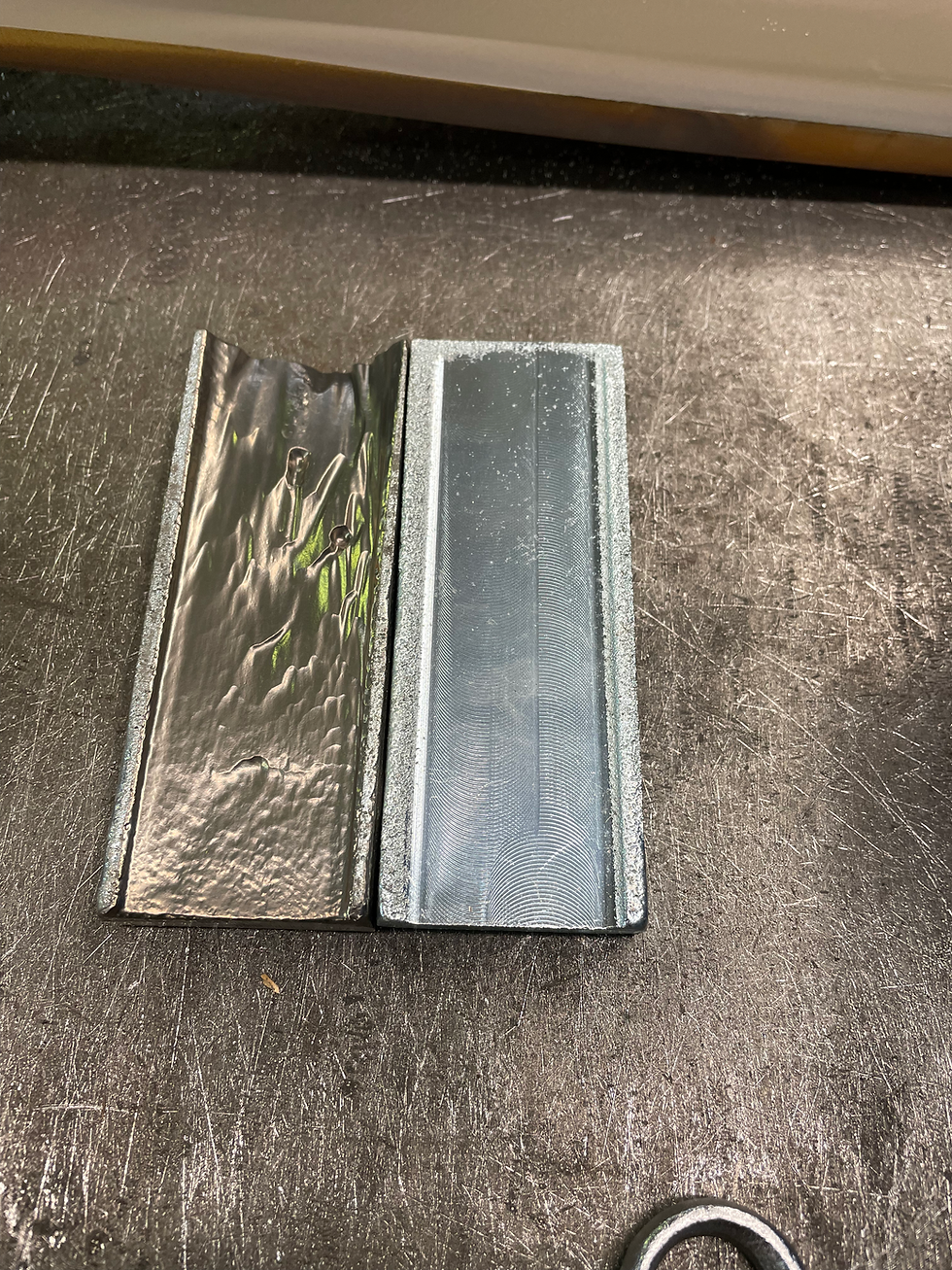
A worn blade next to a new one. This is the easy case: the blast pattern has moved and the reason is visible. The hard case is when the pattern is off and the blade still looks almost new.⬇️
AMS 2432, how shot peening handles drifting.
Every family has that one cousin; the "Lisa Simpson" of the team — not because she is better than the rest of us, but because when she gets it wrong tragedies happen. In our industry that cousin is aerospace, and she did not argue about drift. She studied, recognized and wrote a specification for it.
AMS 2432, Shot Peening, Computer Monitored, keeps the whole set of process parameters under watch — and, more to the point, their combination. Its purpose is to stop several small variations, none of them serious enough on its own to halt anything, from acting together and compromising the result on the part.
So the specification does not trust individual tolerances. It requires you to prove that the worst combination of two parameters, each one still legally inside its own limits, lands inside specification — and if it does not, the limits get tightened until it does. Cross a limit in production and the machine stops by itself within one second, naming the parameter and the moment it happened.
An entire industry concluded that one plus one makes eleven, and wrote it into a standard to skip this trap.
The full peening standard is vast, and expensive to comply with in its entirety. Nobody reasonably expects a simple industrial finishing or mass-production peening process to follow all of it — economically it would be unsustainable.
In medio stat virtus.
Between everything on one side and nothing on the other there is room for a compromise: a handful of parameters chosen for that specific process, enough to keep it under control. On a wheel machine one of them is as simple as motor amperage — outside its limits, the process is stopped — together with a couple of other details. I have put some of these in line myself for clients: they acted after thirty seconds on a cycle of around seven minutes, and that was enough to prevent this kind of problem from developing.
Is this a fault or a drift? How to diagnose in shot blasting.
A fault has a clear root cause. You find it, even if it takes some struggle, you fix it, and things run properly again: one cause, one correction, one result — back properly on track. Example: the elevator belt broke; replace it and run again.
When the results are irregular but everything always seems to be working fine, it is probably drift. When a fix holds for a limited time and the problem comes back in the same or very similar form, it is drift.
Drift is always connected to time passing. It practically never happens to a new machine. It happens to a machine that has had minimal maintenance for a number of years.
Stay on the same component and watch it play out. The elevator belt slips; you tension it, it holds for a week, it slips again. You change it — and now the bearings cannot hold the tension of the new belt, or the shafts have flexed after enough hours of service and no longer keep the pulleys in relative position, so the belt runs off line. Yet the belt keeps turning, almost always. And that is still in the field of visible things.
If instead it starts slipping only slightly, throughput drops, and at the end of the cycle the amps go down for lack of abrasive media reaching the wheel — good luck finding the real cause.
Drift, in two words, is your partner's car.
Once a year we buy everything needed, we pick up our wife's car, we jack it up, and we do the service — the typical oil service. Everything seems okay, and she never complains about the ride, so it is normal to assume everything is working well.
Then one day you actually drive that car. A quick check: the tyre pressure is completely gone, so you set it. It will not hold a straight line — that is the alignment. At a certain speed everything vibrates — that is the balancing. With both of them together the car simply does not stay on the road.
She never noticed, driving it for a few years, because the drift was slow yet inexorable.
After five years, the only reasonable thing to do is to bring the car to the tyre shop and let them fix whatever needs fixing.
Wheel blasting drift summary:
process 4/5 years old and never properly reviewed by a specialist;
inconsistent results without any alarm blinking;
an issue seems fixed and a little later it shows up again; same or pretty similar;
process time increased with apparently no reasons;
abrasive media consumption exploding, again with no reason.
if you are experiencing 2 of the items in the list above probably you have a drift, if you have 3 the drift is a real thing.
Getting a baseline back — why you need help fixing it.
So the drift is real. Now what?
There is no magic wand here, and getting to the bottom of it is not quick. The first thing to understand is what has to be reviewed: the process, not the machine only. You can do a great deal to a machine — parts, upgrades, consumables, settings put back where they belong — and the drift can still be sitting there afterwards, because the cause was never inside the machine.
Take a real example. Five years ago the plant bought abrasive media from one supplier. Then it started buying from two or three, for perfectly sound reasons — and often not even price. The usual supplier simply did not have the product available when it was needed, so you go somewhere else. But the operating mix is now running material from different origins, and the data sheets saying the same thing does not mean the product is the same thing. Whether it actually is, and whether it is consistent, has to be verified rather than assumed — and if it is not, that has to be dealt with.
No mechanical intervention will ever find that. You could rebuild the machine from scratch and the process would keep drifting.
So focusing on the machine alone is already the wrong move. That is why you step back and look at the process in its entirety. Often these blasting machines work for decades, become part of the furniture, and people cannot realise that everything around them has changed.
None of this takes anything away from the people inside the company: the maintenance department, the process engineer, the line manager. It is a different thing altogether. It is the difference between someone who sees one, two, five machines in his own plant, and someone who sees fifty a year in many different plants. That casebook is not something you can build in-house, because in-house the machines are the ones you have.
Here is what it looks like in practice. Walking around a machine with a process problem, I have often ended up simply listening to the dust collector work. Listening, you notice that the air tank pulse does not have that dry snap that tells you the cleaning system is doing its job. That is not something I can explain to you. Either you know it, because you have heard enough of them, or you do not. That is what you are actually buying from a specialist — not the pressure readings on the panel, which will happily sit inside their range while the filter is not cleaning at all.
So somebody with that specific skill gets on a plane, stands next to the machine, and listens to it run.
Which is where this article stops being useful, and for a good reason. A doctor can walk you through a self-assessment over the phone: these are the signs, this is what it means if you have three of them. You can do that part on your own. The therapy is another matter — it depends on you, on what you have already taken, on what you can tolerate, and on where you are geographically located. Drug availability is not the same everywhere in the world. Nobody prescribes over the phone, and nobody expects them to.
Same here. The list above is the self-assessment, and it is yours to run. How the drift actually gets resolved depends on conditions that have nothing to do with the machine.
In my experience the best route is the one that asks for a little more patience. It looks more expensive at the start and it is the safest and the most economically sound at the end. I assess the process live. I analyse everything around it — the incoming parts, the abrasive media, the operators. From there I decide where and how to act, with a parts list and an installation done properly, by hand, to the standard it deserves. Only then do the tests start, on a machine whose consumables and working conditions are genuinely optimal.
And I will be honest to the point of hurting myself here. At that stage the tests go well, and after replacing a substantial series of consumables, redoing adjustments and sorting out seals and gaskets, it often turns out to be impossible to say which parameter, or which two, were the ones furthest out. You have a process that works again and no name for the culprit. It is still a win.
Logistics is part of why. If the client is two hours away by plane or four by car, I can go back and forth: change one component, watch how it evolves, come back. If it is a twelve-hour flight, that method cannot be financed. Every trip has to be maximised, so I do everything that needs doing in the minimum number of visits, rebuild a set of things that run properly, and accept losing the answer to which two or three were the real problem. There is no pre-written recipe here because the ingredients change, and with different ingredients you cannot always cook the same dish.
If you have recognised your process in the list above, that is the step. It does not have to be me. But it has to be somebody, because frankly speaking this is not one you get out of on your own — and the sooner you recognise it, the faster you fix it.
Send me four things: how old the machine is, when it was last properly reviewed, what the abrasive media consumption was a year ago and what it is now.
That is enough for me to tell you whether this is drift, and whether it is worth a visit. It costs you five minutes and it costs me an hour.
AMS 2432 in detail: what computer monitored shot peening actually requires.
This is the appendix for anyone who wants the specification itself rather than the argument built on it. It is not required reading: if the list above already told you what you needed, you can stop here.
AMS 2432, Shot Peening, Computer Monitored, is published by SAE and maintained by the Surface Enhancement Committee, part of the Aerospace Materials Engineering Committee. It sits on top of AMS 2430, Shot Peening, Automatic — the two documents were harmonised deliberately, so that most of the requirements are shared and AMS 2432 adds the monitoring layer on top.
Which parameters have to be monitored, and what happens when one moves.
Table 1 of the specification lists the key process parameters and their shut-down limits. They are: shot flow, air pressure, wheel speed, process time, and the relative position and movement of the part with respect to the nozzle or the wheel.
These are compared by computer against defined limits of variation, continuously, for the whole duration of the process. If the variation exceeds a limit, the machine must shut down automatically within one second, and it must indicate which parameter went out of tolerance and the time at which the violation occurred.
Those parameters must be calibrated at least once every twelve months. The shut-down function itself must also be tested, and records of both the calibration and the tests are retained as evidence of compliance for quality audits.
The requirement that matters most: proving the worst combination.
Paragraph 3.7.2 is the part that concerns everything this article has been describing.
It requires that Almen strip tests are run at the saturation intensity time, to confirm that the required peening intensity range is not exceeded when the process is running at the limits of its tolerance. That is established by two tests.
Test one: maximum permitted pressure combined with the lowest shot flow — which produces the maximum arc height.
Test two: lowest permitted pressure combined with the maximum shot flow — which produces the lowest arc height.
Both results must fall inside the required intensity range. If they do not, the shut-down limits must be reduced until the intensity range is no longer exceeded. These development tests are the processor's responsibility and must be documented so they are available during audit.
Read what that means in plain terms. The specification does not assume that a parameter inside its own tolerance is safe. It requires proof that two parameters, each still legally within limits but leaning in opposite directions, still produce a part inside specification — and where they do not, the tolerance band gets narrowed until they do.
Nadcap: AC7117/1 or AC7117/2?
Nadcap, the global programme for special process quality assurance, distinguishes between computerised and automated peening with two separate checklists: AC7117/1 for Computer Controlled and AC7117/2 for Automated.
Which one applies is dictated by the requirements of the part, not by the capability of the processor's machine. If the part calls for AMS 2432, the /1 checklist is used. If it calls for an automated process to AMS 2430, the /2 checklist is used — even where the supplier's machine has computer monitoring.
Sources: SAE AMS 2432 and AMS 2430; Metal Finishing News, Standards Forum, Paul Huyton. The paragraph numbering above refers to revision D; the current revision is E, published 2022.
Table of contents:
B) Blasting Process Drifting? how to recognize it. this post
Silvio, Jan 14th, 2026, reviewed Aug 20th, 2026

