
Can I Recover Scrap in Aluminum Extrusion?

Updated: Jul 4
If you are not expecting miracles — for which you need a taller ladder and different connections — yes, engineering is enough especially if the L.A.B.S. Method™ for fine finishing is applied: it delivers consistent numbers, especially in the P&L.
What is the average scrap rate in aluminum extrusion?
Around 40% of all cast billet across the full supply chain; at the extrusion plant itself, roughly 24% (mean process yield: 76%). Here is what that means in money:
US — mid-size plant | Reference | EU — mid-size plant |
50 metric Ton (T)/day | Billet input | 35 metric Ton (T)/day |
12 T/day | Extrusion process scrap (~24%)¹ | 8.4 T/day |
$2,500/T | Aluminum price | €2,300/T |
$30,000/day | Process scrap value | €19,320/day |
2.5 T/day | Recoverable scrap (5%) ² | 1.75 T/day |
$6,250/day | Recoverable value | €4,025/day |
$1.875M/year | Annualized (300 days) | €1.2M/year |
¹ Mean extrusion process yield: 76%. Oberhausen, Zhu & Cooper, 2022. Reducing the environmental impacts of aluminum extrusion. Resources, Conservation and Recycling, vol. 179, 106120. University of Michigan, NSF-funded peer-reviewed research. ² Field collected data. Your real number is in your production reports.
These are single-press, mid-size operations. If your plant runs more tonnage, the number scales linearly. Two US presses at 50 T/day each: $3.75M. A larger European operation at 80 T/day: €2.76M.
These are not worst-case figures. They are what surface defect scrap costs when nobody is measuring it — before rework, before late deliveries, before customer returns.
Find your tonnage and size, then multiply to understand YOUR numbers.
Aluminum extrusion is not a single operation. Every profile that comes off the press enters a finishing process before it reaches the customer — anodizing, powder coating, mechanical treatment, or a combination. The intensity varies. The cost does not: finishing is resource-heavy, capital-intensive, and non-optional.
This matters for how you read the scrap numbers above. A defect that originates at the press does not become a cost at the press. It becomes a cost when the profile fails finishing — after extrusion, cutting, handling, and the full transformation cost of the finishing process have already been absorbed.
The rejected profile does not disappear. It goes back into the melt — at a remelting cost, and at a recovery value that is lower than the material it came from. The scrap value in the table is the floor. The real number includes everything that was added before rejection, plus the cost of remelting, minus the difference between primary and secondary aluminum value.
In applications where surface appearance is part of the specification, this dynamic becomes critical. In applications where mechanical performance is critical, surface defects weaken fatigue life — a failure mode that is less visible than an aesthetic rejection, and more consequential.
What the numbers say.
Across the full supply chain, around 40% of all aluminum cast into extrusion billets is scrapped before it ends up in a fabricated product. At the extrusion plant itself, the mean process yield is 76% — roughly a quarter of the billet becomes process scrap before the profile ships. These are the documented figures from the only peer-reviewed material flow analysis of the North American extrusion industry (Oberhausen, Zhu & Cooper, 2022, University of Michigan).
The process scrap is composed of:
Structural losses: butt, charge weld, backend. Consequences of how the extrusion process physically works. Not eliminable.
Surface defects: die lines, streaking, blemishes, dimensional inconsistencies. Process-dependent. Variable. They follow the profile through every subsequent operation until rejection. Based on field collected data, approximately 5% of total extruded weight has issues connected to extrusion line defects. Your real number is in your production reports.
This article focuses on surface defects. Because here is where I can help you.
What this means on a real plant.
A single-press operation running at 50 ton/day — a representative figure for a mid-size US extrusion plant — loses roughly 12 tons of process scrap per day. Some of it is recoverable. Surface defects connected to extrusion line conditions account for 2.5 ton/day on that same press.
At $2,500/ton for aluminum: $6,250/day. Annualized over 300 working days: $1.875M/year.
On a single press. Before accounting for the cost of rework, late deliveries, and customer returns.
This is not a theoretical number. It is what surface defect scrap costs when nobody is measuring it.
US — mid-size plant | EU — mid-size plant | |
2.5 T/day | Surface defect scrap | 1.75 T/day |
$6,250 | Daily cost | €4,025 |
$1.875M | Annual cost (300 days) | €1.2M |
Understanding the issue.
The numbers above describe a problem that exists in every extrusion plant. The structural losses are fixed. The surface defects are not.
After extrusion, profiles are inspected. Those with visible surface defects go back into the melt. Those that pass move forward into finishing. But the inspection is not perfect — some defective profiles pass. And finishing introduces its own variables: a profile that exits extrusion within specification can be damaged during anodizing, powder coating, or mechanical treatment. This is not negligence. It is process engineering — every additional operation is an additional source of variance.
The result is the same in both cases: profiles that fail at the end of the process, after the full transformation cost has been absorbed, go back into the melt at a value lower than the primary material they started as.
That gap — between what you put in and what you recover — is the real cost of surface defect scrap.
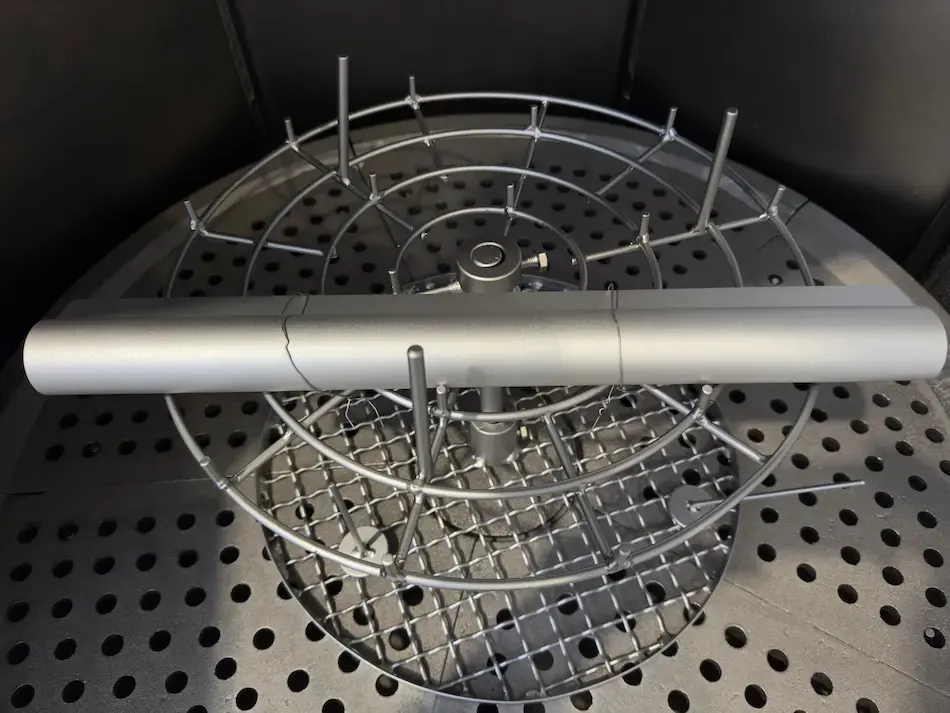
There is a way to close it. Not by changing how you extrude — by recovering what you would otherwise lose. The equipment class built for this application is the APB.
A note on aesthetic applications.
The framework above applies to all extrusion operations. The numbers, however, are not equal across applications.
In industrial extrusion — structural profiles, technical sections, mechanical parts — a surface defect that falls within dimensional tolerance often passes. The profile does its job. The cost of that defect is absorbed.
In any application where surface appearance is part of the specification, the same defect is a rejection. Architectural profiles are the clearest example: a die line on a facade panel, a surface streak on an anodized window frame, a blemish on a curtain wall section. These are not borderline calls. The customer sees them. They come back.
Anodizing and powder coating make every surface defect permanent and visible. The transformation cost at the point of rejection — extrusion, cutting, surface treatment, handling — is fully embedded.
In plants where surface treatment follows extrusion, the cost of a rejected profile is not the cost of aluminum. It is the cost of aluminum plus extrusion plus cutting plus treatment plus handling. The scrap value in the table is the floor. The real number is higher, and it grows with every step the defective profile completes before rejection.
The variable scrap problem in aesthetic applications is not just a yield problem. It is a delivery reliability problem and a customer relationship problem.
The tolerance for process drift is zero. Not low — zero.
Before you size a machine, size the number.
Everything above is the industry benchmark — the 40%, the $1.875M. But the only figure that matters for your decision is how much of that scrap is actually recoverable in your plant, with your profiles, your finishing mix, your defect distribution. That number is not on this page. It's in your production data.
That's exactly what the first step is for: a free remote assessment of your real figures. No sales visit, no equipment pitch — we look at what you're actually losing and tell you what's realistically recoverable, and whether it's worth going further. If the honest answer is "not enough to justify it," you'll hear that too.
Put it in proportion: verifying this costs €2,500. The scrap you're carrying, if the benchmark is anywhere near your reality, costs that every few days. Checking before you invest is probably the best risk-to-return decision in the whole project.
A) assessing the problem. this post - for CXO and operations Managers.
B) equipment that solves the problem and why. for operations Managers and Process engineers.
C) answer to final question, is it worth it? - for CXO and operations Managers.

