Recovering Aluminum Extrusion Profiles: What the Wheel Blaster Actually Does.

Updated: Jun 4
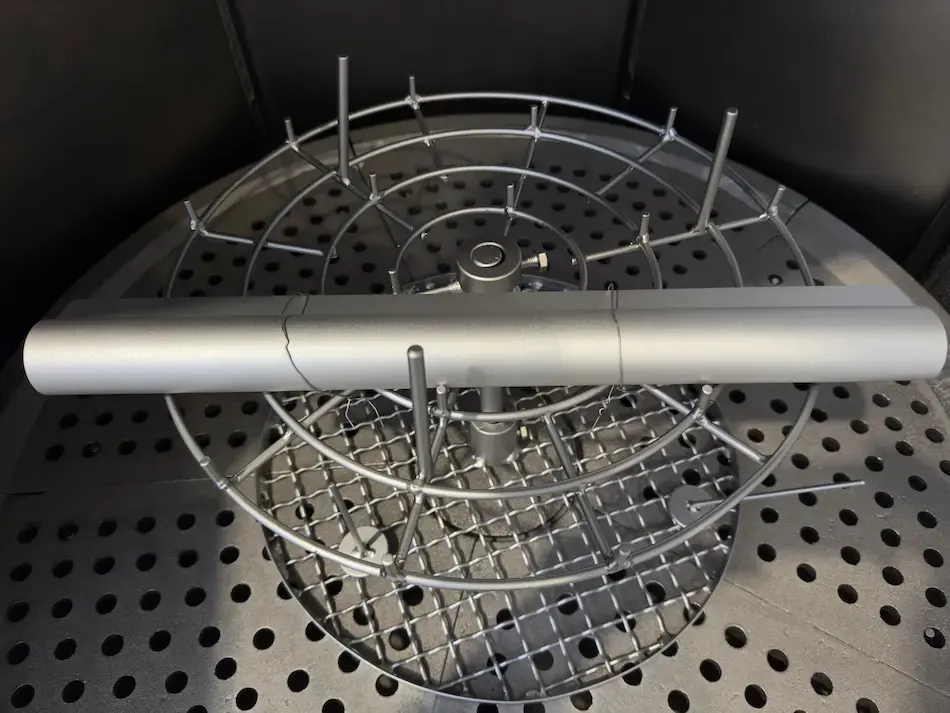
A wheel blaster is not complex equipment. It projects the right blasting media at controlled velocity against the profile surface. One parameter defines the process: the speed at which the profile passes through the machine. Set it once for each scenario. The rest is automatic.
What changes across scenarios is what the machine is removing — and what happens to the profile afterward.
The process: how it works - and how to remove die lines from aluminum profiles.
The profile enters the machine on a conveyor. Blasting wheels project the right media at controlled velocity against the surface. The impact removes whatever is on the surface — aluminum oxide, extrusion lines, anodic layer, powder coating — without affecting the underlying material. No chemical reaction. No material dissolution. No weight loss.
The speed of passage controls the intensity of the treatment. Slower passage means more impact per unit of surface. Faster passage means lighter treatment. One parameter, set once per scenario, defines the result. See below:
The equipment: Specs and configurations here.
Scenario 1 — Post extrusion: surface defect removal.
The profile exits the press with surface defects — die lines, streaking, blemishes. It enters the wheel blaster. The blasting removes the defects from the surface without touching the underlying aluminum. Profiles exit with their full weight intact and a homogeneous surface, clean and chemically pre-activated, ready for the next operation.
If the next operation is anodizing, the mechanical etching is already done. The chemical bath does not need to work — it only needs to fully activate the surface. Two minutes instead of twenty. The caustic soda has no time to dissolve aluminum. Weight is preserved. Sludge is reduced by 90%.
Scenario 2 — Post anodizing: defective layer removal.
The profile has been anodized. The anodic layer has defects — visible after the bath, visible to the customer. The profile enters the wheel blaster. The blasting removes the anodic layer completely. The aluminum underneath is intact, at full weight. The profile goes back into the etching bath — mechanically pre-treated, two minutes of chemical activation — and is re-anodized.
No weight loss. No remelting. The profile that would have gone to the furnace goes back into the process instead.
Scenario 3 — Post powder coating: defective coating removal.
The profile has been powder coated. The coating has defects — contamination, adhesion failure, surface irregularities. The profile enters the wheel blaster. The blasting removes the coating completely. The aluminum underneath is intact. The profile goes back into finishing — mechanically pre-treated, ready for re-coating.
Same principle as Scenario 2. The wheel blaster resets the surface. The profile re-enters the process at the point where it failed. Nothing is lost except the defective layer.
What is constant across all three scenarios.
The aluminum does not lose weight. The profile does not go to remelting. The machine runs one variable — passage speed — set once per scenario. The process is automatic.
Percentage of the profiles perfectly treated: 99%.
Loading, unloading and operational considerations.
The loading and unloading system is a separate engineering question, dependent on the plant layout and profile dimensions. It is evaluated case by case — but the evaluation matters.
A typical throughput of this blaster for window profiles — one of the most common products in this industry — is approximately 1.5 ton/hour. Managed manually, that requires two operators at loading and two at unloading. Four people dedicated to moving profiles through a single machine. In developing markets with low labor costs, this is manageable. In developed markets, it is not — the labor cost alone changes the economics of the entire operation.
Automation of the loading and unloading system is not optional in high labor cost environments. It is the variable that determines whether the process is viable.
On the machine side, the opex picture is different. The blasting media used for aluminum profiles is not cheap — but it has a long service life. At the fine grain sizes required for this application, consumption remains extremely low. The process generates little waste and minimal wear on the machine's internal components. A well-built wheel blaster operated correctly has an operational life in the range of 20 to 30 years.
Low opex. Long asset life. The variable that needs engineering attention is handling — not the machine itself. Today it is possible to build the handling frame to feed directly into the etching bath and the anodizing line — because after blasting, the less the profiles are touched, the better. Manual handling at this stage reintroduces contamination and defeats the purpose of the process.
The waste generated by the blasting process is a flammable dust that requires careful handling and proper containment. The handling system, the integration with the anodizing line, the dust management — these are not afterthoughts. They are engineering decisions that define whether the process delivers its full potential or creates new problems.
This is why a plant-specific analysis comes before anything else. The machine is simple. The integration is not.
Book the consultation here: https://calendar.app.google/1kQSfJmKeQvtRjTZ6
Summary of contents:
A) assessing the problem. for CXO and operations Managers.
B) equipment that solves the problem and why. - this post - for operations Managers and Process engineers.
C) answer to final question, is it worth it? - for CXO and operations Managers.