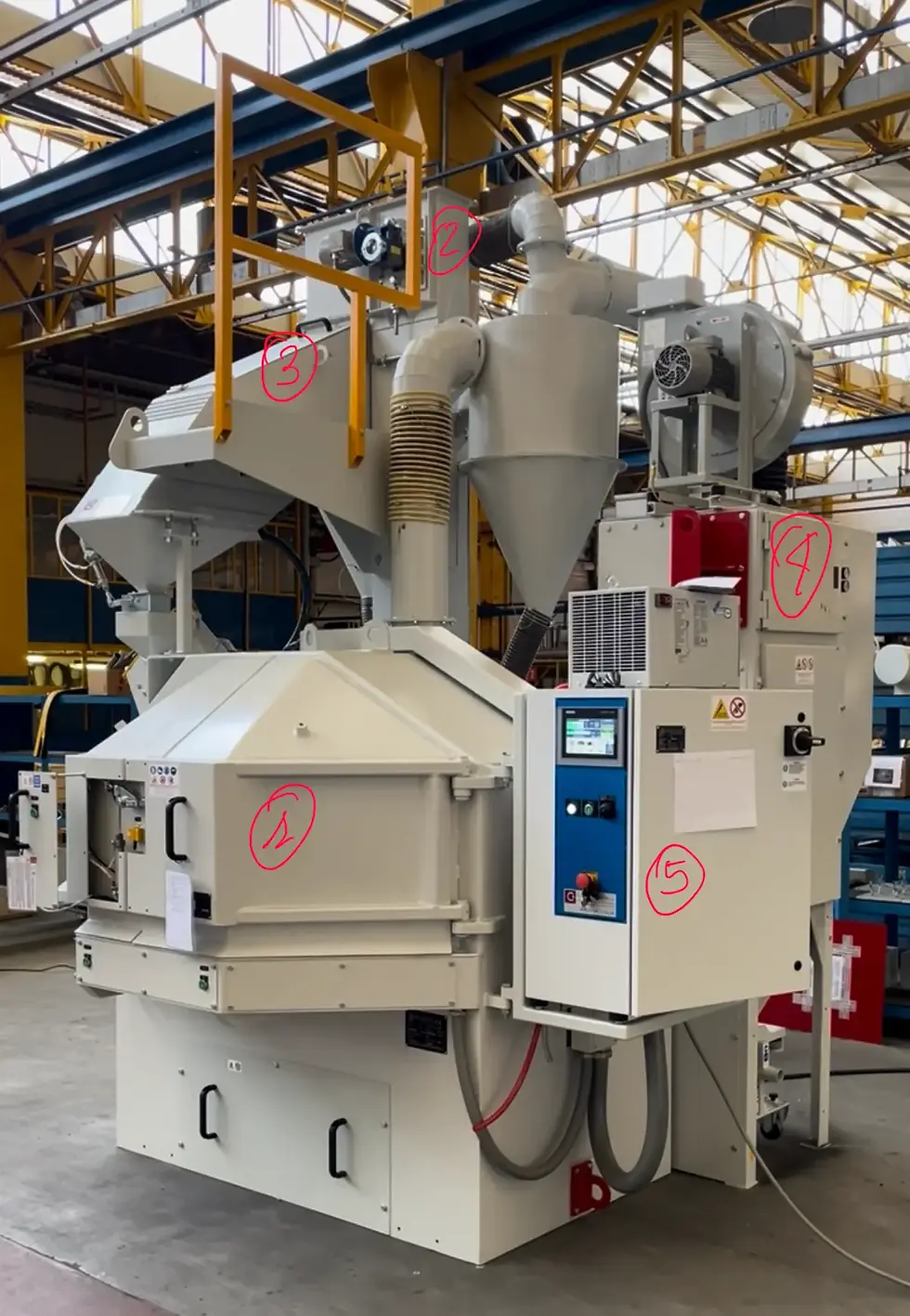
TAB: Rotary Table Shot Blasting Machine — Single Blast Wheel.

Updated: Sep 14
A rotary table shot blasting machine is a closed airless cabin with a horizontal rotating table and a single blast wheel mounted on top; it works on batch and by cycle time.
Parts are laid flat on the table, the table turns them through the direct media flow, while the rest of the time rebounding media keeps the process going.
One face never gets treated in one single cycle: the one resting on the table.
🚨Issues on this machine?🚨
Vortex — troubleshooting from your phone, specialist one tap away.
What a table blast machine does well.
A table blast machine works best on 2D parts — length and width dominate, height stays modest. Simple extrusion dies are the clearest example: flat, one face to clean, nothing to take apart. Springs are another: descaling after heat treatment or shot peening, both on classic coil springs and on the flat springs used in automatic transmissions.
Huge plus: the operator has direct access to the cabin, so in principle it gets inspected every cycle. Load and unload can be automated in several ways where the volume justifies it.

Where turntable shot blasting machines are used:
Glass industry — mold cleaning
Aluminium extrusion — die maintenance
Tire manufacturing — mold cleaning
Post heat treatment descaling
Casting industry deburring
...and a long list of others. If your part/process is not here, ask.
Table type shot blasting machine: sizes and capacity.
Workable Dimension (mm) | Max Load (kgs) | Size Equipment | Max Load (LBS) | Workable Dimension (inches) |
Ø 500 x H 450 | 500 | 5 | 1100 | Ø 20 x H 18 |
Ø 1000 x H 450 | 1000 | 10 | 2200 | Ø 40 x H 18 |
Ø 1400 x H 450 | 1400 | 14 | 3100 | Ø 55 x H 18 |
Ø 1800 x H 450 | 1800 | 18 | 4000 | Ø 71 x H 18 |

How a rotary table shot blasting machine works.
A rotary table shot blasting machine — also sold as table type shot blasting machine or turntable shot blasting machine — is a closed cabin with a horizontal rotating table and the blast wheel mounted on top, aimed so the jet covers the parts laid on the table.
Overview about the machine works and deep dive on the main components here, while the batch equipment spectrum is here.
How to choose your table blaster size in 4 steps
Make sure your bigger part fits inside, leaving about 20% of room for optimum media coverage.
Measure how long takes to load parts in and out; this timing is what limits your production capacity, not the cycle time — focus here.
Make sure the equipment fits in your shop or production line, if needed can be usually shortened; remember for maintenance and safety you need walkable space around the machine itself.
You will have to compromise anyway, so list your wishes then compromise where needed, the right upgrade like a fixture or a cart can solve plenty of issues with a little extra to pay upfront.
Upgrades and satellite table fixtures
Satellite fixtures, drum configurations, load and unload automation. Which of them makes sense depends on the parts. Full list and specifications: accessories and technical upgrades.
Table blaster: coverage and technical details
Workable dimensions. These are the real workable envelope, not the physical table diameter. See the blast pattern drawing. If parts occupy 80% or more of the space available, a coverage analysis is needed — that is where blind spots appear.
Working height. 450 mm (18 inches) as standard on all sizes. Working height can be modified according to the parts to process — a size 10 built at 750 mm for extrusion dies is shown below.
Coverage. The side facing the table needs flipping. Complex geometries may need more than one blast wheel, which is established by coverage analysis before the layout is fixed.
Blast wheel. 5.5 kW (7.5 hp) direct drive as standard, up to 11 kW (15 hp). Media flow rate from 90 to 140 kg/min (200 to 310 lbs/min).
Media. Steel shot, stainless steel shot and derivatives below 50 HRC, aluminium shot, cast iron or steel grit. Above 50 HRC a carbide kit is worth having. Ceramic media runs with its own kit.
Dust collector. Built-in unit, sized on the cabin. ATEX or NFPA 660 configuration depending on the destination market.
Automation and control. Siemens as standard for CPU, HMI and drives, Allen Bradley available. Automatic media gate control, with pre-programmed blasting and peening setups recalled by the operator on one button.
How a wheel blast machine is built, component by component: Blaster or Peener: How a Wheel Blast Machine Works.
Layout and footprint. Footprint drawings for plant layout are issued on request, 2D/3D and DWG. Downloadable tech specs:
Need more on this type of machine? Book a call below, or send your questions through the contact page.
If you are evaluating a purchase — whatever machine you have in mind, whatever brand — we can go through it together and see whether it actually answers everything you need.
All dimensions and information here stated are for informative purposes only and subject to change without notice. Please refer to drawings and specs attached to your own quote.